Monday, February 23, 2009

Sepia Tones and onOne Frames


The tutorial on sepia tones was really interesting and helpful. I've never been taught to create a sepia tone this way, and I like it a lot because it gives images so much more depth than just a flat filter or color wash would. The frames were also fun to use, but I would rather learn how to make my own frames with brushes. Regardless, I was very happy with the way my images turned out.

Monday, February 16, 2009

Edward Burtynsky Screening


I think that the subjects of Edward Burtynsky's work are very unique from most photographers. His interest is in manufactured landscapes and landscapes that have been, you could say, renovated by man. Photographing this type of subject seems to have been a great learning experience for Burtynsky because of all of the research that goes into finding the sites (such as mining sites or quarries), getting permission to photograph there, and actually learning about how the sites came to be the way that they are. It was interesting to hear from Burtynsky how he initially began researching these manufactured landscapes.

When I first saw the image above, I thought it was a drawing or some sort of illustrated image. It took my eyes a few seconds to adjust before I realized and could see exactly what I was looking at. I enjoy that quality about Burtynsky's work. With many of his images, I tend to feel a curiosity towards the subject of the photo, and because of that it's nice to hear his narrative along with it.

Tree of Life Nursery

On Saturday, January 31, I woke up early to get ready to head up a little ways north of San Diego to the Tree of Life Nursery in San Juan Capistrano. Andy and I met up in the school parking lot at 8am to carpool there and back. When we got there, he put his things into my car, got in, and then we left. So far it was looking to be a really beautiful day. The sun was bright, and the sky was clear and a deep, blue color. Even along the coast on the drive up the I15, there were no clouds in the sky.

Andy and I were the first people to show up besides Deborah. She showed us around for a little bit, naming native plants for us. The three of us came across a great manzanita tree, blooming with white flowers and full of humming birds. The morning light shining in on the tree was really nice. We pulled out our cameras, and began shooting, trying to get a shot of the humming birds without scaring them off. Unfortunately, I did not have a nice enough lens to get a close up shot of them, but I think that I have some nice ones of the tree, and you can see the tiny birds in some of them.


From there, we continued to photograph other native plants and things around the nursery. Many more manzanitas, sycamores, and other plants and trees. I found a thorny bush entangled in barbed wire, which I thought was an interesting composition as well. Andy, Cameron, and I even took pictures of one of the dogs that was hanging around the nursery. He was adorable, and it was kind of cool that he had two different colored eyes.


At 10am, everyone gathered up with Abe Sanchez to hear him speak about basket weaving. I thought it was very interesting to hear what he had to share. He is very determined to preserve the native traditions, which includes basket weaving. Never had I realized how much work goes into basket weaving or how hard it is to accomplish. Sanchez had some beautiful baskets and other woven things with him that were great for photographing.


Shortly after hearing Sanchez, Andy and I headed home. Heading back down the I15 we were both relieved and glad that we had gone up early for the field trip. First of all because the morning seemed like such an ideal time to be taking photos, and second because the traffic going north on the I15 was almost completely stopped! What a bummer that would have been. I think that we both enjoyed the trip quite a bit and caught some really interesting shots.

Monday, February 2, 2009

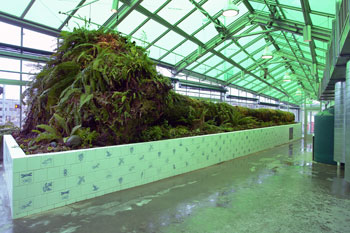
Mark Dion Video


I thought that Mark Dion's work was very intriguing because it brought up a few different issues that have become very relevant today. In the process of relocating the tree to serve as a sort of sculpture, Dion had to duplicate the conditions of the trees original, natural habitat. It seemed like he did an impressive job at this. I thought that the contrasting relationship of the man-made environment to the tree said a lot about globalization and how are technological advances in society are having an effect on all of natural life. These days it seems like technology is trying to reproduce everything in order to make it better, faster, or more efficient, and I don't think that the best that technology can do would compare to the natural progression of life. I was facinated by how complex the man-made habitat was that Dion created for the tree, and how it supported so many different forms of life.

Dion also brought up that this piece was a living work of art, which means that it is something that takes constant commitment and maintenance to keep up. I have noticed that a lot of art is currently an ongoing process. Artists seem to be more interested in interactive and ever-changing works of art rather than final completed pieces. Art is becoming more of an ongoing process and experience, which parallels with our society's obsession with gaining experiences.

Scott Calhoun: A Lake Of Pure Sunshine


Scott Calhoun's narrative of his trip to Lancaster to photograph wildflowers was a very entertaining read. Not only was he specific about the types of native plants that he encountered, but he also delivered a humorous account of his experience.

I enjoyed the way that Calhoun wrote about the Joshua trees especially. I remember the first time I ever saw a Joshua tree. I was spending the weekend in 29 Palms with my best friend's sister and her family. If you have ever driven out in that area, you know that there are thousands of Joshua trees all over the landscape as far as you can see. I usually don't think of the desert as an interesting place to see, but between the windmills and the Joshua trees, there is always an interesting view in that area. It was easy to relate to Calhoun's description of the Joshua trees as well as the other plants that he came across.

I think that the images that Calhoun chose to post with his story complemented it very well. It was great to have such a description of what he saw that was less technical and more subjective, and then to see the actual image. I really liked Calhoun's style of writing and I actually enjoyed reading this although I didn't initially think that I would have any interest in it.